Light installations and performances underground – MOME artists at the Kőbánya Underground festival
Spatial installations underground
AJSA Collective’s installation Stalactite Creatures takes its cue from the atmosphere of caves, with elongated and spherical light forms hanging from the ceiling near Tesla coils casting a soft, coloured glow and giving the space a distinctly cave-like feel.
Dániel Besnyő’s light installation LAST SIGNAL is an abandoned monitoring station that has continued to scan its surroundings. It sweeps the space in all directions, as if the last radar system of humanity were still running without its creators. The work is a collaboration between Dániel Besnyő, Bence Tóth-Meisels, Zoltán Czingáli, Centrum Production, LEDRON Ltd., and Áron Pfitzner (LIGHTFORM light art agency).
Exploration, by Bökény Balogh and Márton Merényi, uses the dark spaces of the cellar system as its medium. With a single movable light source, visitors could create shadow play and bring the otherwise static space to life.
In The Ladder Inside Me, Tádé Biró, Bálint Pattantyús, and Attila Péter use programmed light moving across vertically suspended elements to play on the idea of the ladder. The sense of moving up the ladder shifts into a circular, cyclical movement, carried by pulsing light sequence running along the installation’s LED tubes.
Time and material
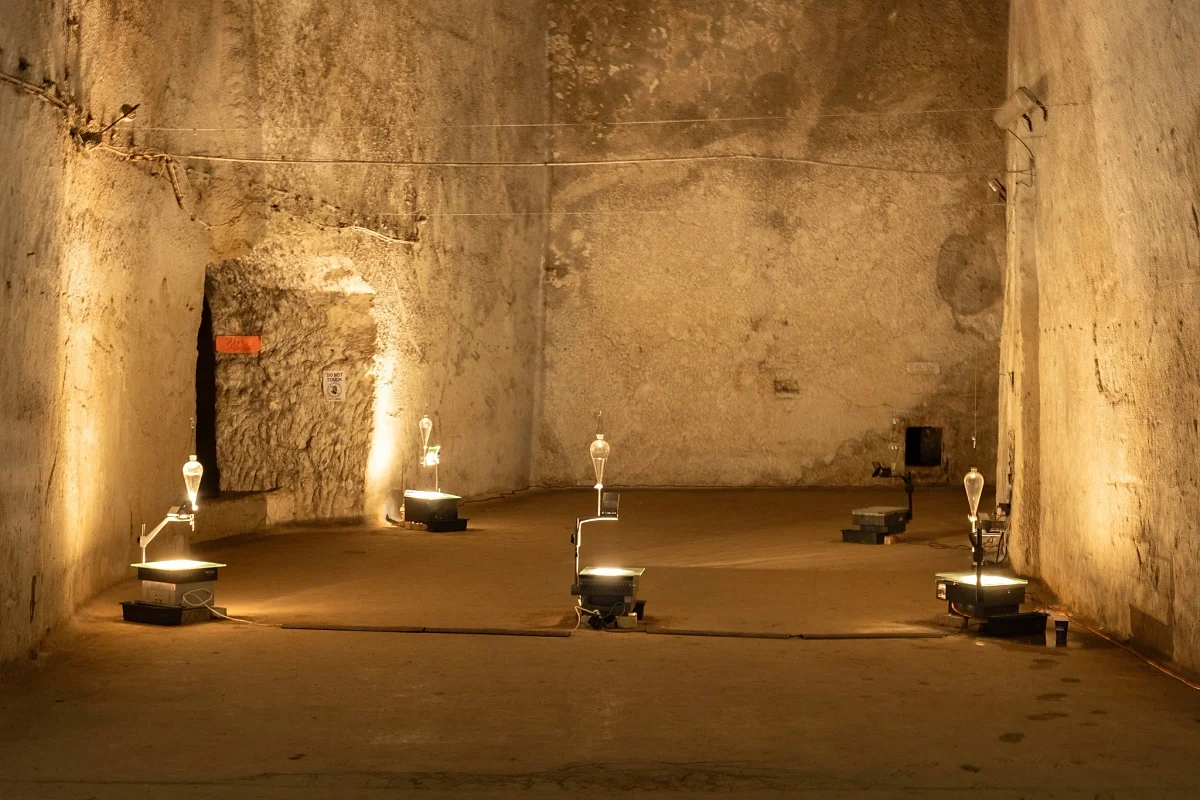
Ilona Karácsony and Karoline Ketelhake’s installation Homeostase 2.0 uses analogue projection to show crystallisation in real time. Salt solution drips onto the projectors, evaporates in the heat of the lamps, then crystallises, forming constantly shifting organic patterns across the projected surfaces.
Emma Forgách’s kinetic installation Taroudant explores the relationship between the visible and the invisible. The image never settles into a fixed form; its interpretation changes depending on when you look, how closely you look, and how long you look.
Jimmy Dave Zénón’s work Zénón (I) centres on the experience of time falling out of joint. The phasing phenomenon known from sound art – repeating cycles slipping out of sync – creates a new sense of temporality within the space.
Interactive systems
Lőrinc Fazakas’s installation FEEDBACK GHOST is built on the logic of digital feedback. The viewer’s mere presence – even a hand movement in front of the camera – sets off a self-generating visual process that continues to unfold on the projected surface over an extended period.
The audiovisual installation Stratification by Péter Buzás, Lajos Czeglédi, Botond Dremmel, Szabolcs Fábián, and Mátyás Müller draws a parallel between a mine’s industrial structure and the geological layering of nature. The generative sound and light system condenses the slow, almost imperceptible natural processes into a perceptible form.
Panna Makai and Fülöp Szabó’s initEchoe project is built around a live-coding-based visual synthesiser. The system responds in real time to the space and presence within the cellar network, with the projected visuals generated directly from the immediate environment.
Painting with light, archive, and performance
Through the works of Bence Bánhidi-Rózsa, Réka Horváth, and Diki Luckerson, the Kozmothorosz pop-up exhibition approaches contemporary painting from the perspective of phenomenology and performativity. The paintings appear not as representations, but as traces of events that have taken place.
Janka Kováts’s textile installation Held in Tension examines the relationship between space, material, and participant through a system of suspended objects. The structure does not take on a predetermined form; its final configuration is shaped by the conditions of the site and the behaviour of the material.
The Kozma Archive × Party Archive Research Group installations draw on archival videos, posters, and VJ material to evoke the early visual culture of Hungarian techno and party scenes, also featuring artists affiliated with MOME’s predecessor.
The Rés collective’s multimedia installation and performance My Father’s Daughters explores the formation of female identity through the internalised paternal gaze and male gaze. Drawing on their own bodies and personal experiences, the artists trace how self-image is shaped by the pressure to conform, the constant sense of being observed, and the process of becoming an adult.
In Troglodyte, Molnár Zoltán, Vass Aranka Adelina, and Horváth Júlia work with the ambivalence of spatial perception. The auditory component unfolds as a continuously shifting soundscape, emerging through the breaking up and recombination of its own elements. The visual component moves along the intersections of physical and digital space, reconstructing the experience of the observed environment through video, drawing, 3D, and generative software.
An experimental cultural space beneath the city
Kőbánya Underground once again showed how industrial spaces beneath the city can function as experimental cultural environments. Working with light, sound, and installation, the projects draw on the site’s physical conditions to engage with the communal dynamics of underground culture, creating opportunities to test new forms of media art.
Several MOME students and alumni were involved in organising the event, including Laura Fedics, Gergő Borhi, Balázs Budai, Dániel Ökrös, and Bence Tóth-Meisels.
More news