Students from MOME’s first Rome residency programme debut at the Hungarian Academy in Rome
The residency’s first edition focused on Rome’s public spaces as a medium, particularly the relationship between street art and the city’s cultural heritage. “Instead of Rome’s museums and historic landmarks, our focus this time was the streets themselves. We began with the city’s famous “talking statues” – Pasquino, Marforio, Madama Lucrezia and others – which since the 16th century have served as a running critique of both secular and ecclesiastical power, commenting on the anomalies of public affairs through anonymous satirical messages, poems and posters. That exchange continues across the city’s public spaces, from tags that crop up everywhere, through often sharply political graffiti, to the colourful, large-format murals across the outskirts. In this layer of the city, swirling on the surface, largely unselfconscious and full of chatter, we looked for meanings that remain accessible to an outside observer, while seeking to keep our intervention at a level that doesn’t cross into intrusion”, said Miklós Erhardt, the first mentor of the student residency programme established in 2024.
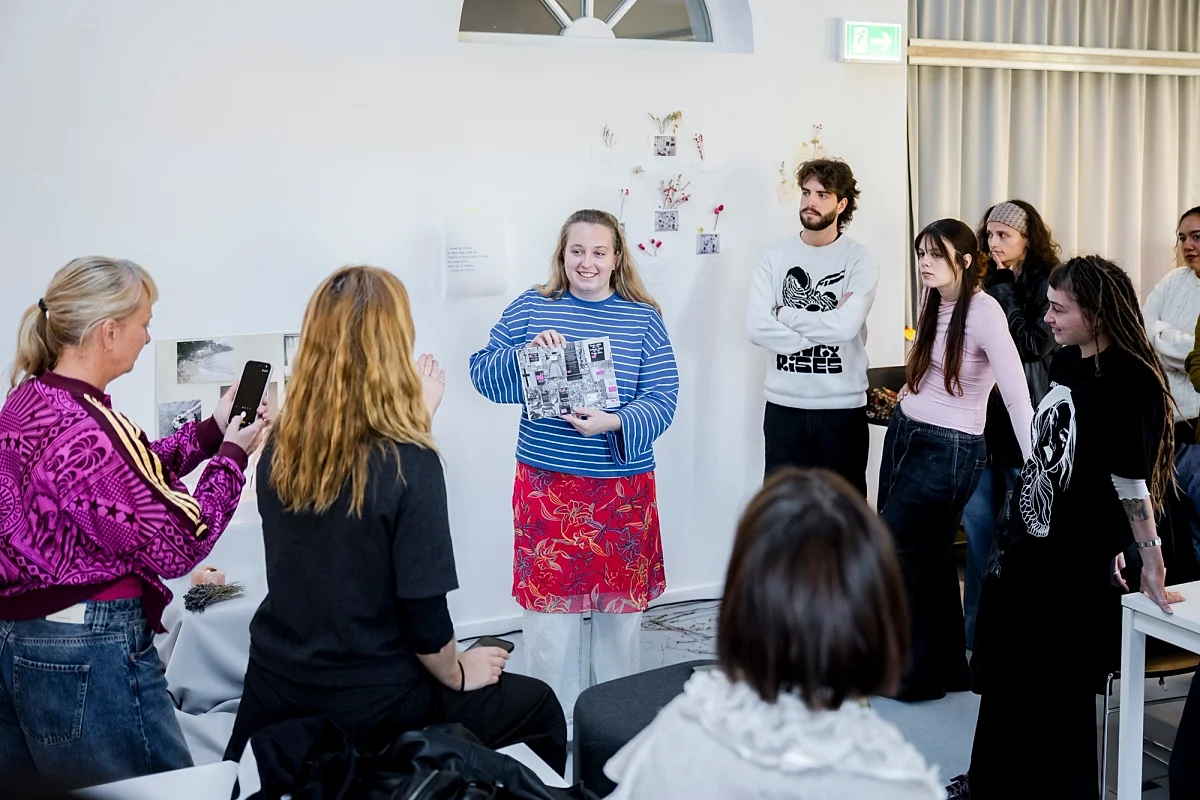
The first scholarship recipients of the Rome Student Residency Programme were Fülöp Benjamin Bechtold, Sára Holczer, Csongor Boldizsár Nagy, Eszter Tóth, Szonja Urbán, and Aranka Adelina Vass, who took part in professional preparation sessions and field research at the Rome Hungarian Academy during their four-week stay in July. After returning home, they continued developing their projects for several months, culminating in the exhibition Site Inspection. Working across a range of media and methods, the projects examine informal, non-canonical aesthetic phenomena and the cultural, social, and technological layers of Rome’s public spaces.
In ANYA, Szonja Urbán superimposed her own tag onto a map of Rome, then walked the resulting route – a journey of almost 200 kilometres. Sára Holczer also used walking as the basis for her project, drawing on the chance documentation of a looping route around the Vatican walls. For Tickets, Please!, Csongor Boldizsár Nagy recreated one of Rome’s ticket machines, which dispenses tickets defaced with graffiti he collected across the city. Drawn to the grotesque letterforms found in graffiti, Eszter Tóth developed her own crocheted alphabet, then used it to make two large white flags by hand, bearing the words “TOY” and “BITE” – both loaded terms in graffiti slang. Aranka Adelina Vass’s Noise Lens focused on the strange poetry of electrical equipment in public space. She measured its electromagnetic noise and translated it first into concrete music, then into printed visual patterns. Fülöp Bechtold documented names and inscriptions scratched into Rome’s walls, capturing them in clay impressions as a way of examining urban memory and anonymity, and the traces individuals leave behind.
MOME and the Collegium Hungaricum Rome share a commitment to supporting students as they embark on their careers and build an international profile. For MOME, the residency offers international professional experience, a research setting, and an opportunity for students to develop their own artistic and design questions within the rich cultural and historical Roman landscape.
This year, the programme is once again offering six students the chance to spend four weeks at the Hungarian Academy in Rome in July. The residency includes a preparatory course, fieldwork, and a group exhibition showcasing the resulting projects in the gallery at Palazzo Falconieri.
Exhibition: Site Inspection
Opening: 11 June 2026, 7:00 p.m.
Venue: Hungarian Academy in Rome
The exhibition is on view until 30 September 2026
Admission is free.
Travel costs for the participating professionals, faculty, and students were partly covered by the Tempus Public Foundation and the Pannónia Scholarship Programme.
More news