Twenty years of the Moholy-Nagy Award – Where visions of the future meet
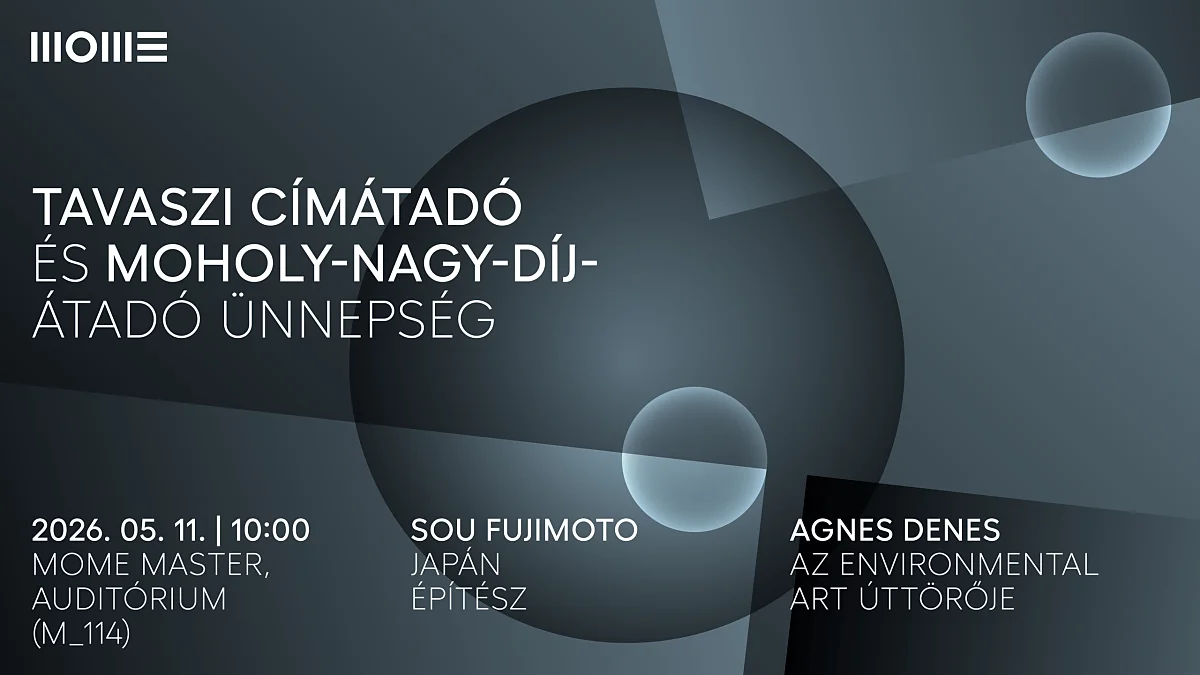
Unconventionally, this year’s Moholy-Nagy Award goes to two artists rather than one: world-renowned Japanese architect Sou Fujimoto and Hungarian-born, internationally recognised visual artist Agnes Denes (Ágnes Dénes). The award honours those who embody social awareness, a sense of responsibility for the future, and openness to creative experimentation in their work – all of which continue to define Moholy-Nagy’s legacy today.
The award ceremony will take place on 11 May as part of the university’s spring title award ceremony. The event not only celebrates Denes’s more than six-decade-long career and recognises Fujimoto’s work, but also provides an opportunity for the university to restate what it means to bear Moholy-Nagy’s name, which it adopted in 2006, the same year the award was established. The event is more than just a ceremony: it is a clear confirmation that Moholy-Nagy’s ideas on education remain relevant at MOME amid ongoing changes, and that his worldview continues to guide both theoretical and practice-based teaching.
In this anniversary year, the award highlights two artistic careers in dialogue with each other. Although the recipients come from different generations, cultural contexts, and fields, they share a common way of approaching the questions of the future. Even when reflecting on crisis situations, rather than offering simple answers, they create work that engages with both the natural and social environment. Denes emphasises the power of hope, while Fujimoto expresses a sense of optimism about the future.
Agnes Denes’s creative oeuvre, shaped by a universal outlook, and her large-scale projects that reinterpret spaces and landscapes draw attention to the Earth’s fragility, humanity’s responsibility, and the power of human values. She creates her work for humanity as a whole, bringing together human and non-human elements, as well as mathematics and visual art. In parallel, Sou Fujimoto’s architectural practice explores the relationship between the natural and built environment. His buildings, which create new spatial experiences, highlight the importance of human scale, liveability, and shared experience, while reflects on the relationship between the human body and architecture.
The international and Hungarian ties of the two recipients reflect both MOME’s global outlook and the importance of its cultural roots. The combination of architecture, visual art, and responsible thinking reinforces the sense that the most exciting issues in contemporary creative work emerge at the intersections of disciplines. The relationship to nature, responsibility the built environment carries, social awareness, and a sense of responsibility for the future are all central to both bodies of work, just as they are core values at MOME.
For twenty years, the Moholy-Nagy Award has honoured artists for their creativity, integrative thinking, intellectual innovation, and responsible practice. It was designed to set Moholy-Nagy’s ethos as a model for future generations. As Moholy-Nagy put it, “education can become a tool for a happier and healthier life” – the future can be shaped for the better through a deeper understanding of the relationship between science and art, and between people, nature and technology. Awarding two recipients this year continues that tradition, showing that Moholy-Nagy’s legacy remains a living, evolving, and relevant intellectual framework.
More news