Design for mental wellbeing – MOME back at the Researchers’ Night
MINDSHIFTS – The Role of Design in Mental Wellbeing introduced visitors to interdisciplinary research and design projects exploring mental health, recovery, and social relationships through design. From virtual experiences of nature and a board game designed to help people connect to objects reflecting on personal experiences and creative exercises, the projects offered many opportunities for discussion and shared reflection. It showcased interdisciplinary research and design projects demonstrating how design thinking can support mental health, recovery, rehabilitation, learning and social connections, as well as help change public attitudes.
Design is about much more than aesthetics or functionality. Our surroundings, the objects we use, and the ways we interact with technology all influence our mental and physical health. Thoughtful design can create safer environments, encourage positive behaviours, open up new ways of connecting with others and help people express deeply personal experiences.
Digital technologies supporting mental health
One of the programme’s highlights was Zenctuary VR+, a research project exploring how virtual reality can help reduce stress and anxiety in patients receiving long-term care. Developed through an international clinical collaboration involving Ágnes Bakk, Pál Tamás Szabó, and Beáta Sosity from the MOME Future Care Lab, alongside Patrícia Lajkó and Beáta Réka Vásárhelyi from Semmelweis University, the project looks at how an interactive, explorable virtual environment inspired by nature might boost motivation, support emotional regulation, and encourage more active participation among patients spending extended periods in hospital.
Two projects by Zsófia Kérdy – Refårm, and AntiSelbst – demonstrated other ways digital technology can be used. Refårm offers activities that recreate aspects of nature in environments where access to the natural world is limited, helping people in prison, among others, cope with confinement. AntiSelbst is an augmented reality (AR) platform for self-exploration that combines psychodrama with Jungian depth psychology. Using digital masks, it encourages users to step outside their familiar roles and explore less accessible aspects of their personalities.
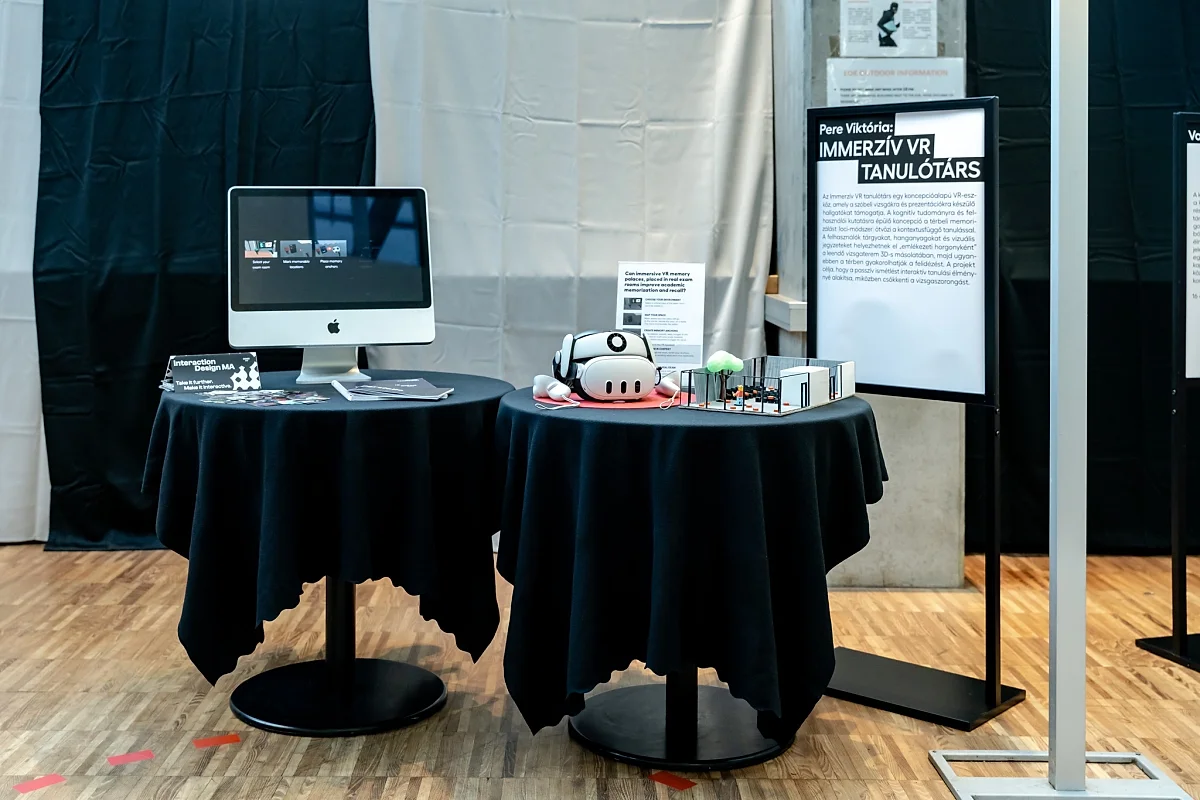
Technology is also playing an increasingly important role in education. Viktória Pere’s Immersive VR Study Companion combines spatial memory techniques with context-dependent learning to encourage active engagement and reduce exam anxiety. Students can place visual, auditory, and object-based memory cues in a virtual exam environment to help them recall what they have learnt.
Processing trauma and exploring personal experiences
MINDSHIFTS went beyond exploring the potential of technology. Another key focus was processing trauma and finding ways to give physical form to personal experiences. The projects brought experiences of mental health difficulties, psychiatric treatment and eating disorders to the fore, alongside the challenges of connecting with others.
Virág Luca Boncz’s installation Possible Side Effects – Disorder draws on her personal experience of living with panic disorder. Through medical records, diaries, textiles, and personal materials, the installation makes the experiences of anxiety, treatment, and recovery tangible, while raising questions about vulnerability, care, and self-acceptance.
Cintia Vaspöri’s anti-stigma project, Pure Madness, challenges the prejudices surrounding psychiatric experiences. A diary, self-awareness and art therapy workbooks, and a workshop for participants to create identity flags provide ways to share personal experiences and challenge public perceptions.
Konnekta, a psychology-based board game by Aranka Adelina Vass and Eszter Lóki, explores how people can build meaningful connections. Designed for two to six players aged 16 and over, it encourages participants to express their thoughts and feelings by arranging 3D-printed objects into compositions, creating a safe space for open and honest communication.
CTRL+ALT+CRIP, a magazine by Beáta Sosity and Dániel Csángó, examines the intersections of disability, design, art, technology, and knowledge gained through lived bodily experience. It challenges the idea that disability is simply a problem to be solved, presenting it instead as a source of experience and insight that can help us rethink and redesign both our surroundings and the way society works. Dorottya Vértessy’s Can You Eat All? maps the relationship between anorexia nervosa and eating. Through tableware that subverts familiar functions, the project makes the thoughts and behaviours associated with the eating disorder more tangible, encouraging greater empathy for those living with the condition.
Exhibition, discussions, and hands-on projects
The MINDSHIFTS exhibition brought together a wide range of personal experiences and circumstances, touching on everything from long-term care, anxiety, stress and self-awareness to eating disorders and human relationships. What united the projects was their use of design not only to highlight challenges surrounding mental wellbeing, but also to introduce new ways of engaging and communicating with others, along with practical approaches to coping with these difficulties.
Alongside the exhibition, the programme featured presentations, themed roundtable discussions and guided tours. Visitors also had the opportunity to try out the Zenctuary VR+ experience and play the Konnekta board game.
More news